If you are weighing up a review service, you want a straight answer on return. Most providers will tell you reviews are "worth it" and leave it there. That is an assertion, not an analysis. This guide gives you a way to check for yourself. You will see how reviews connect to conversion rate, local visibility, and customer acquisition cost. You will also get a simple worksheet that turns your own numbers into a clear review service ROI UK owners can defend.
Why Most ROI Claims Fall Short
Search for the value of Google reviews for business, and you will find bold statements everywhere. Reviews build trust. Reviews boost sales. Reviews help rankings. All of that can be true, but none of it helps you decide whether to spend money.
A useful answer needs your numbers. How many people view your profile? How many become customers? What is each customer worth? Without those figures, any ROI claim is a guess.
So treat general claims with caution, including ours. The framework below works because it uses your data, not ours.
The Three Levers Reviews Can Move
A review service does not create profit directly. It changes three things that sit upstream of profit.
1. Conversion Rate
Reviews act as social proof. When a stranger compares two similar businesses, review count and rating often tip the decision. A stronger profile can turn more of the people who find you into enquiries, bookings, or sales.
This is the link between reviews and conversion rate. It is also the lever you can measure most easily, because you can count enquiries before and after a campaign.
2. Local Visibility
Google says local results rely on relevance, distance, and prominence. Review count and review score feed into prominence. More genuine, recent reviews can therefore help you appear in the local pack more often.
More visibility means more people see your profile in the first place. That raises the top of your funnel. We explain the mechanism in our guide on how reviews affect local SEO rankings.
3. Customer Acquisition Cost
Customer acquisition cost is what you spend to win one new customer. If reviews help more visitors convert, each new customer costs you less. Reviews also keep working after the campaign ends, because they stay on your profile.
That makes cost per customer from reviews a useful comparison against paid ads, directories, and other channels.
The ROI Formula
Keep the maths simple. Use this formula:
ROI (%) = (extra profit from reviews − campaign cost) ÷ campaign cost × 100
Each part has a plain meaning:
- Extra profit from reviews: the additional profit you earn because more people choose you.
- Campaign cost: what you pay the provider.
- ROI: the return on each pound spent, shown as a percentage.
A positive result means the campaign paid for itself. A negative result means it did not. The skill lies in estimating "extra profit" honestly.
Your ROI Worksheet
Work through these five steps with your own figures.
Step 1: Record Your Baseline
Write down what happens today, before any campaign:
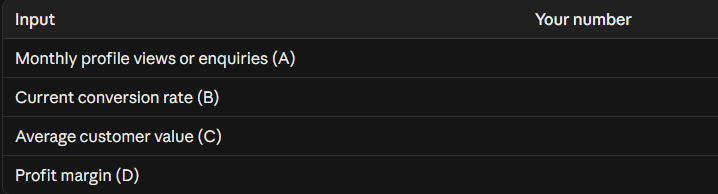
Your Google Business Profile insights, booking system, and sales records usually hold these numbers.
Step 2: Set a Cautious Uplift
Choose a modest improvement in conversion rate. Pick a figure you could defend to a sceptical accountant. Be conservative, because reviews do not guarantee a fixed result.
Step 3: Calculate Extra Customers
Multiply your monthly views by the uplift in conversion rate. That gives you extra customers per month. Multiply by 12 for a yearly figure.
Step 4: Calculate Extra Profit
Multiply extra customers by average customer value, then by your profit margin. This is your extra profit from reviews.
Step 5: Work Out ROI and Cost Per Customer
Apply the formula above. Then divide your campaign cost by your extra customers to get your cost per customer from reviews. Not sure what number to enter for cost? Here is what a Google review service costs in the UK.
A Worked Example
The figures below are illustrative. They are not Omni Reviews prices, and they do not predict your results. Swap in your own numbers.
Imagine a salon with these inputs:
- 500 monthly profile views
- 6% of viewers book, which gives 30 bookings
- £60 average booking value
- 50% profit margin
- A £600 campaign cost for the year
Now suppose conversion rises from 6% to 7%. The salon gains 5 extra bookings a month.
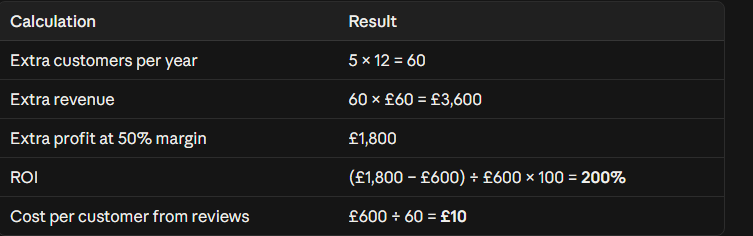
Run the same sums with a smaller uplift to test the downside. If the uplift is half as large, extra profit drops to £900, and ROI falls to 50%. The campaign still pays back, but by a smaller margin. Testing a low case and a high case shows you how much risk you are taking.
How to Read Your Result
No universal benchmark exists for a "good" ROI. Instead, use these comparisons:
- Against other channels. Compare your cost per customer from reviews with what ads or directories cost you.
- Against your payback period. Ask how many months of extra profit cover the campaign cost.
- Against your downside case. If the low-uplift scenario still breaks even, the decision is safer.
A campaign that wins on two of these three usually deserves a serious look.
Value the Formula Cannot Capture
Some benefits resist neat measurement. Reviews give your business more social proof when customers compare options. They also answer common questions before a customer calls. Your own replies to reviews show new customers how you treat people.
None of this belongs in the formula, so the formula slightly understates the value. Still, keep your decision grounded in the measurable part. Treat the rest as a bonus.
When a Review Service May Not Be Worth It
An honest ROI analysis sometimes says no. A review service may not suit you if:
- You have very few customers. A small list limits outreach, so the campaign has little to work with.
- Your service has unresolved problems. Real reviews reflect real experiences. Fix quality issues first.
- You already collect reviews steadily. If your own process works, outsourcing adds less.
- You cannot track results. Without baseline numbers, you cannot judge return.
Knowing this protects you. A provider that tells you when the numbers do not work is more trustworthy than one that always says yes.
Why Compliance Belongs in Your ROI
Cost is not the only number that matters. Risk belongs in the calculation too.
Since April 2025, the DMCC Act has banned fake reviews in the UK. The Competition and Markets Authority can fine a business up to £300,000 or 10% of global turnover, whichever is higher. Platforms also remove reviews they consider unreliable. Any removed review is money spent for nothing.
Cheap reviews from unrelated accounts therefore carry a hidden cost. A compliant service works only with your real, verified customers, so its reviews are far less likely to be flagged. That lowers your downside, which improves your risk-adjusted return. Omni Reviews builds every campaign around this principle.
Applying the Framework to Each Platform
Different platforms deserve different assumptions.
On Google, stronger reviews can lift both visibility and conversion. Ready to grow your profile? Our Google Reviews service is the best place to start.
Be careful with Yelp. It controls which reviews customers see, so keep your uplift figure small. Once the maths works, you can explore our real Yelp reviews service with confidence.
Frequently Asked Questions
Is a review service worth it for a small UK business?
It can be, if you have enough real customers to contact and your numbers support it. Use the worksheet above to test your own case before you commit.
How do I calculate review service ROI in the UK?
Subtract the campaign cost from your extra profit, divide by the campaign cost, and multiply by 100. Estimate extra profit from your views, conversion rate, customer value, and margin.
Do reviews really improve conversion rate?
Reviews act as social proof, so they often influence choices between similar businesses. The size of the effect varies, so measure your own enquiries before and after.
What is a good cost per customer from reviews?
There is no fixed figure. Compare it with your cost per customer from other channels, such as ads or directories.
Can a provider guarantee a return?
No honest provider can. Customers decide whether to respond and what to write, so results vary. Be wary of any guaranteed return or star rating.
Run the Numbers, Then Decide
A review service is a business decision, so treat it like one. Gather your baseline, test a low and a high case, and compare the result with your other channels. If the maths works, you can commit with confidence. If it does not, you have saved yourself money.
Run the numbers, then start with Omni Reviews.